I think we entered Thailand from the wrong end. Or rather, we got off too soon, as it were.
We left Singapore by train, because the bloke in Seat 61 said it was one of the great journeys, and since the 30s-built High Modernist station on the south of the island is closing (in fact, it closed about two weeks after we used it) this would be our last chance. Well, the bloke was wrong.
The station was run-down and grubby (in contrast to everything else in hyper-efficient Singapore, a puzzling factlet until someone explained that the station and railway line are actually part of Malaysia, a remnant of the time before Singapore was kicked out of the federated states), and the views of Singapore and Malaysia not impressive enough to justify the 14-hour journey to Butterworth.
However, it did mean a few days in dear old George Town again. Which was nice.
Then by minibus to Krabi. Ten hours. With flaky aircon. Oh the agonies of international travel! Poor unfortunate us! etc.
Just over the border into Thailand we passed the scene of a recent MVA: a fatal dispute between a BMW (same model as yours, Jo) and a motorbike. The BMW was a write-off, and so was the biker, whose body lay 10 metres behind the car, where I guess it was thrown by the force of the impact.
Two-wheeled transport is everywhere here and we'd seen plenty of minor accidents but this was the first fatality - all the more surprising when you consider that bikers in SE Asia trust in the protective powers of flip-flops, shorts and a back to front shirt or jacket (to keep the chest from being chilled, we were told). Helmets are also treated as optional. And it's not uncommon to see two adults sandwiching a child or two, zipping along.
A common misspelling, seen at places where they have stuff for hire, is mortobike.
And so, Krabi. Sorry, Linsey and Ihman, but I found it a charmless collection of concrete boxes balanced on several hills. It's a jumping-off point for the island in the Andaman Sea, where we quickly jumped.
Koh Phi Phi used to be a sleepy island of small fishing villages. Then a beach on the island was used for The Beach, and the DiCaprio fans descended in hordes. Augmented by those looking for the perfect beach unsullied as yet by tourism. Of course, when thousands of tourists head somewhere because there are no tourists, the reason for going soon ceases to exist. I recognise my own complicity, being one of the tourist throng. It's a problem without solution (but, as the Austrian economists keep telling us, there are no solutions in the realm of human action, only trade-offs).
However, I have some rudiments of dignity, hard won through years of embarrassment and humiliation; unlike the twentysomethings who would happily climb into the thai boxing ring in the reggae bar in the main town and go a round with a professional for the promise of a bucket. A bucket? One of the favourite annihilators for the young and/or reckless in party-mad Thailand: a quarter bottle of spirits and two cans of soft drinks emptied into a little bucket, topped up with ice. Buy one, get three seemed a common offer. Or be punched and kicked by an angry Thai for 90 seconds, get one.
The beaches on KPP were lovely - what you could see of them underneath last night's beach party remnants: bottles (some broken), buckets, divorced shoes, abandoned clothes, plastic crap of every kind.
I don't know about you, but when I see broken glass on a beach I pick it up (I can't help but think of that boy in the public safety information film, running along the beach towards the pile of broken glass). On KPP, you could spend the whole day clearing up after the night before and not be done.
We thought we'd chosen accommodation far enough away from the main town not to be bothered by the all-night beach parties, where we could sit on the porch of our bamboo shack and watch the sunsets. Well, the sunsets were spectacular but the crescent shape of the bay meant that all the sound from the beach was focused, as a satellite dish focuses the extraterrestrial signal, on to our hut. We'd already paid, rashly, for five nights before we found this out. I considered suicide.
Don't get me wrong. Twenty years ago I'd probably have thought an all-night party island to be the coolest thing ever. But now I like other things more; like not feeling my bed throb to the basstastic sounds of happy hardcore, chart and party.
The water was fantastic for swimming, however, and we might have been persuaded to go elsewhere on KPP but the rains came. So we headed west and north to Phuket.
The only thing I'm going to say about Phuket its that the h shouldn't be silent. Don't go. For the love of the wee man, don't go.
The Andaman coast being rained out, we decided to chance our luck on the opposite coast and try the Gulf of Thailand. Which has proved to be mostly heavenly.
When I said we entered in the wrong place, I mean we should have come here first - it's everything you dream of when you hear the name of Thailand. White sand as soft as 00 flour, water like sheets of green and blue jewels, reefs teeming with fish just off the beach.
It was a long and hungry journey getting to Koh Tao but the beauty of Chalok Bay on the south of the island makes it all worthwhile. We stayed there 10 days and thought about staying for the rest of our lives...
But Koh Phangnan next door was calling, with its promise of full-moon parties.
But that's for next time.
(No pictures, because I've written and am sending this from my phone. I was thinking of writing a novel on my phone about a man writing a novel on his phone about a man writing a novel on his phone ad infinitum. Now I'm not so sure.)
Tuesday, 21 June 2011

Monday, 20 June 2011

Where are we? Click that pic and you should be taken to Picasa, where there'll be a map at the right of the page. Play around with it (I recommend turning on the satellite view from the drop-down menu at top right, and also zooming out a little) and you'll get a pretty accurate geolocation for us.
I've been trying to blog these pics from my phone, with limited success: the pics appear, and a click takes you to Picasa, but the EXIF doesn't create a nice map. Instead, it lists the lat and long coordinates as numbers. Any ideas, Jools? (Or anyone?) Using Android on a Motorola Defy, have my Picasa and Blogger accounts nicely linked and everything. It's most frustrating, as I'd like to be able to take a pic with my phone, stick it in Picasa and then stick it on the blog so that the image can be clicked and show the map rather than the coordinates...
Saturday, 18 June 2011


Thursday, 16 June 2011

This is
a test, sent from my phone. The white sand is very fine on this beach and some has got into helena's lens housing. Will get it cleaned in hong kong
Monday, 6 June 2011
Singapore: the future, now!
This is the view I'm looking on to as I type:
And now, from the balcony:
At the left you can see the Buddha rock - it looks a bit like a seated Buddha.
We're now on Koh Tao, an island in the Gulf of Thailand (if you follow my Tweets, you'll know this already. Go on: follow my Tweets – my handle is tri_bre). Sitting here listening to the profound silence of a low-season seaside town, I can affirm quite heartily: it really was worth the effort to get here. We'll be staying for ten days in this room:
Just before I recap all our recent rovings, let me share with you the two best typos I've yet seen in Thai menus, both from the drinks sections. One place offered Irish Wishkey, which is apt beyond words, and another stocked Jack Denials, which sounds rather like the drink for the morning after the night before.
Last we spoke, Helena and I were heading to Singapore. As everyone says, Singapore is incredibly clean and efficient – and not just compared to its garbage-strewn neighbours. Check out this helpful sign present above every train door:
In Singapore, you're not allowed to make such a mistake – wastes vital seconds you know. And by helpful I mean nannying.
They also have plastic money – I mean the banknotes are made of polymer film with a holographic watermark and braille dents. (They also have the same historical personage on every denomination – some bloke called Yusof bin Ishak, first president of independent Singapore. I'll share my thoughts on the semiotics of currency art later.)
But it's not just the sci-fi money that makes Singapore feel like you've entered a William Gibson novel. There's the architecture – Singapore has to be the most unabashedly postmodernist place I've ever seen. This is a museum of some sort:
And this is a shopping mall:
And this is a hotel:
Note the museum, bottom left.
I'm still not certain whether all three blocks are part of the hotel, or just the boat on top. But up there is a massive pool and a palm-tree garden. At night they fire off a laser and Kleig light show. It's like living in Blade Runner. (Without Harrison Ford. Or the origami unicorns. But they do have similarly serious rain, it being the tropics.)
We were also amazed at how cheap Singapore was. Admittedly our postcard-sized room was in a hotel in the red light district (one of them, that is – prostitution is legal in Singapore), so that made it less expensive than a similar hotel in a better area. But you could find cheap food wherever you looked – and also extremely expensive food, Singapore being one of the richest and most prosperous places on the planet. Among the many delights: breakfast porridge made of wheat and served with sesame paste. I dream of it still.
Transport was cheap – and it's a great walking city. We walked 20 miles on our second day there, easy. Admittedly I did chafe my buttocks something terrible, but at no point in our long wander around the central section, Chinatown, Little India and back east to our Geylong hotel did we feel as if we had seen enough. The streets of Singapore are broad and the buildings are not piled up against each other like the termite mound I had imagined. There are plenty of parks and green spaces – neat and clean of course, some with signs informing you that the area is for 'casual recreation only'. Just in case you wanted to have some formal recreation, I suppose.
(A note on maps: I started out with good intentions to map our every step. But 1) it's an enormous drain on mobile battery power and 2) the interface developed some bugs, and who has the time or the inclination to troubleshoot an interface? Particularly when there is food begging to be sampled at every turn. So I may try and work out what went wrong, but if it proves to require more than 20 minutes work I can't promise anything. Anyway, I've enabled Twitter to mark its location. Not quite a map, but better than nothing. So - follow my Tweets.)
Singapore is also genuinely polyglot - every ticket seller on the subway seemed fluent in English, Mandarin, Malay and Tamil, the republic's four main languages. I was very impressed.
We did catch an amazing sunset:
So we both fell in love with Singapore, and are now busily thinking of ways we can engineer a longer stay there. All suggestions welcome. Points will be deducted for references to red-light zones.
Stay tuned for first impressions of Thailand, coming soon (flakiness of internet connection permitting).
 |
| From Koh Tao |
And now, from the balcony:
 |
| From 2011_06_05 Koh Tao |
At the left you can see the Buddha rock - it looks a bit like a seated Buddha.
We're now on Koh Tao, an island in the Gulf of Thailand (if you follow my Tweets, you'll know this already. Go on: follow my Tweets – my handle is tri_bre). Sitting here listening to the profound silence of a low-season seaside town, I can affirm quite heartily: it really was worth the effort to get here. We'll be staying for ten days in this room:
 |
| From Koh Tao |
Just before I recap all our recent rovings, let me share with you the two best typos I've yet seen in Thai menus, both from the drinks sections. One place offered Irish Wishkey, which is apt beyond words, and another stocked Jack Denials, which sounds rather like the drink for the morning after the night before.
Last we spoke, Helena and I were heading to Singapore. As everyone says, Singapore is incredibly clean and efficient – and not just compared to its garbage-strewn neighbours. Check out this helpful sign present above every train door:
 |
| From Singapore |
In Singapore, you're not allowed to make such a mistake – wastes vital seconds you know. And by helpful I mean nannying.
They also have plastic money – I mean the banknotes are made of polymer film with a holographic watermark and braille dents. (They also have the same historical personage on every denomination – some bloke called Yusof bin Ishak, first president of independent Singapore. I'll share my thoughts on the semiotics of currency art later.)
But it's not just the sci-fi money that makes Singapore feel like you've entered a William Gibson novel. There's the architecture – Singapore has to be the most unabashedly postmodernist place I've ever seen. This is a museum of some sort:
 |
| From Singapore |
And this is a shopping mall:
 |
| From Singapore |
And this is a hotel:
 |
| From Singapore |
Note the museum, bottom left.
 |
| From Singapore |
I'm still not certain whether all three blocks are part of the hotel, or just the boat on top. But up there is a massive pool and a palm-tree garden. At night they fire off a laser and Kleig light show. It's like living in Blade Runner. (Without Harrison Ford. Or the origami unicorns. But they do have similarly serious rain, it being the tropics.)
We were also amazed at how cheap Singapore was. Admittedly our postcard-sized room was in a hotel in the red light district (one of them, that is – prostitution is legal in Singapore), so that made it less expensive than a similar hotel in a better area. But you could find cheap food wherever you looked – and also extremely expensive food, Singapore being one of the richest and most prosperous places on the planet. Among the many delights: breakfast porridge made of wheat and served with sesame paste. I dream of it still.
Transport was cheap – and it's a great walking city. We walked 20 miles on our second day there, easy. Admittedly I did chafe my buttocks something terrible, but at no point in our long wander around the central section, Chinatown, Little India and back east to our Geylong hotel did we feel as if we had seen enough. The streets of Singapore are broad and the buildings are not piled up against each other like the termite mound I had imagined. There are plenty of parks and green spaces – neat and clean of course, some with signs informing you that the area is for 'casual recreation only'. Just in case you wanted to have some formal recreation, I suppose.
(A note on maps: I started out with good intentions to map our every step. But 1) it's an enormous drain on mobile battery power and 2) the interface developed some bugs, and who has the time or the inclination to troubleshoot an interface? Particularly when there is food begging to be sampled at every turn. So I may try and work out what went wrong, but if it proves to require more than 20 minutes work I can't promise anything. Anyway, I've enabled Twitter to mark its location. Not quite a map, but better than nothing. So - follow my Tweets.)
Singapore is also genuinely polyglot - every ticket seller on the subway seemed fluent in English, Mandarin, Malay and Tamil, the republic's four main languages. I was very impressed.
We did catch an amazing sunset:
 |
| From Singapore |
 |
| From Singapore |
So we both fell in love with Singapore, and are now busily thinking of ways we can engineer a longer stay there. All suggestions welcome. Points will be deducted for references to red-light zones.
Stay tuned for first impressions of Thailand, coming soon (flakiness of internet connection permitting).
Thursday, 19 May 2011
News in briefs
Off to Singapore tomorrow, so here's a round-up of recent things.
1) Ijen - volcanic location in East Java. Steep ascent to the crater's rim and steeper descent into the bowels of the earth. There's a lake in the crater, heavy on the sulphuric acid, and a sulphur mine where blokes harvest elemental sulphur and sell it to a local sugar refinery. They make about $15 a day carrying up to three loads, 75-100kg a time, up and down the mountain. If ever anyone needed capital in the form of machinery, it's these guys.
The lake seethes with underwater activity:
2) Bali, paradise isle of mystical stuff.
We landed on the west coast of the island, at Gilimanuk. Lonely Planet gets it wrong again shock - far from a steady stream of minibuses hurtling to all points of the island day and night, the transport pretty much stops mid-afternoon. And taxis don't bother coming to the port, even though it connects Bali to Java. I know, it makes zero sense. We waited for a minibus to slowly fill up - three hours.
Got to Pemuteran, spent the night in luxury:
Then on to the banana minibus the next day, to Lovina:
The driver stopped several times en route along Bali's north coast road to load up sacks and sacks of bananas. And passengers, although most of them weren't in sacks.
Lovina is where we encountered a new kind of infestation in the bedding - some kind of beetle, a few of them winged. They weren't bedbugs, but don't know what they actually were. Woke up a few times with new bites (especially on the back of my head, underneath my hair) and also one time with our little beetle friends crawling on me.
Town quiet and sleepy, its somnolence punctured only by the crowing of the cocks and the distant rumble of thunder. And the perpetual offer of 'dolphin tour tomorrow?' from every man we passed on the street. We did get some super diving in, at Menjangan Island:
Thanks to Mogens and Bente for sharing those pics.
Then to Ubud, which is rife with hippies offering to recalibrate your chakras and unlock your astral DNA. We went to a performance of traditional dances, including the legong. I won't explain the story - it seemed a pretty pointless narrative to me. Look it up if you must. The costumes were sumptuous:
but the music sounded like scaffolding falling down a well. I could tell it was meant to sound as it did, because the gamelanistes stopped and started in unison, but it was completely impenetrable to your humble Rover.
We were all ready for leaving Ubud when I got bitten by damn monkey. Chance of rabies: tiny but not zero. Consequences of rabies: agonising death, 100% of the time. So we had to stay three extra days while the docs derabified me. Boring.
It wasn't this monkey that bit me. Now that I am immune to monkey bites, I have a mind to grab one and thrash it, for retribution.
From Ubud we went further south, to Padangbai, which is one of the loveliest places on earth. It was so lovely, we forgot to take pictures. We were too busy being astounded by beauty. Sorry. We did some more diving (and pictures may follow - we're deep in negotiation with an American for the rights), of the wreck of the USAT Liberty. As if being torpedoed by the Japs in '42 weren't enough, it was sitting on the beach at Tulamben when an eruption of the volcano Anung threw it into the deep, where it has slowly mouldered and grown a coral overcoat.
Now we're in Kuta, which is the tourist heart of Bali. It's full of souvenir shops selling tat and places offering sausage and chips. And men offering me Viagra as I walk past. It's an odd thing to be trying to sell, isn't it? Your opening gambit is effectively to accost a man and say: I'm guessing that you're having a certain kind of problem, one that strikes deep at your sense of being and self, and I - a total stranger - now want to sell you some counterfeit medicine.
Kuta beach is an immense crescent of deep gold sand, pounded by the surf that attracts gnarly dudes from all over the world. We stood and watched as surfer after surfer fell off their boards, which was a grand way to spend a half hour.
So flying off to Singapore tomorrow, a strict and very clean country where they birch you for spitting, dropping litter or owning a dog. Or maybe it's dropping Spit the Dog. It's all very very confusing.
Do click through to examine our Picasa web albums at your leisure and pleasure. The pics themselves are worth 1000 words. Each. If you like em, we can get them to you wholesale.
Until next time.
1) Ijen - volcanic location in East Java. Steep ascent to the crater's rim and steeper descent into the bowels of the earth. There's a lake in the crater, heavy on the sulphuric acid, and a sulphur mine where blokes harvest elemental sulphur and sell it to a local sugar refinery. They make about $15 a day carrying up to three loads, 75-100kg a time, up and down the mountain. If ever anyone needed capital in the form of machinery, it's these guys.
 |
| From Ijen Plateau and Sulphur Mine, Java |
The lake seethes with underwater activity:
 |
| From Ijen Plateau and Sulphur Mine, Java |
2) Bali, paradise isle of mystical stuff.
We landed on the west coast of the island, at Gilimanuk. Lonely Planet gets it wrong again shock - far from a steady stream of minibuses hurtling to all points of the island day and night, the transport pretty much stops mid-afternoon. And taxis don't bother coming to the port, even though it connects Bali to Java. I know, it makes zero sense. We waited for a minibus to slowly fill up - three hours.
Got to Pemuteran, spent the night in luxury:
 |
| From First night in Bali, at Pemuteran |
Then on to the banana minibus the next day, to Lovina:
 |
| From Banana Express, Bali |
The driver stopped several times en route along Bali's north coast road to load up sacks and sacks of bananas. And passengers, although most of them weren't in sacks.
Lovina is where we encountered a new kind of infestation in the bedding - some kind of beetle, a few of them winged. They weren't bedbugs, but don't know what they actually were. Woke up a few times with new bites (especially on the back of my head, underneath my hair) and also one time with our little beetle friends crawling on me.
Town quiet and sleepy, its somnolence punctured only by the crowing of the cocks and the distant rumble of thunder. And the perpetual offer of 'dolphin tour tomorrow?' from every man we passed on the street. We did get some super diving in, at Menjangan Island:
 |
| From May 7, 2011, Bali Scuba diving |
 |
| From May 7, 2011, Bali Scuba diving |
 |
| From May 7, 2011, Bali Scuba diving |
Thanks to Mogens and Bente for sharing those pics.
Then to Ubud, which is rife with hippies offering to recalibrate your chakras and unlock your astral DNA. We went to a performance of traditional dances, including the legong. I won't explain the story - it seemed a pretty pointless narrative to me. Look it up if you must. The costumes were sumptuous:
 |
| From 2011_05_09 Legong Dance, Ubud Palace |
but the music sounded like scaffolding falling down a well. I could tell it was meant to sound as it did, because the gamelanistes stopped and started in unison, but it was completely impenetrable to your humble Rover.
We were all ready for leaving Ubud when I got bitten by damn monkey. Chance of rabies: tiny but not zero. Consequences of rabies: agonising death, 100% of the time. So we had to stay three extra days while the docs derabified me. Boring.
 |
| From 2011_05_11 Sacred Monkey Forest Sanctuary |
It wasn't this monkey that bit me. Now that I am immune to monkey bites, I have a mind to grab one and thrash it, for retribution.
From Ubud we went further south, to Padangbai, which is one of the loveliest places on earth. It was so lovely, we forgot to take pictures. We were too busy being astounded by beauty. Sorry. We did some more diving (and pictures may follow - we're deep in negotiation with an American for the rights), of the wreck of the USAT Liberty. As if being torpedoed by the Japs in '42 weren't enough, it was sitting on the beach at Tulamben when an eruption of the volcano Anung threw it into the deep, where it has slowly mouldered and grown a coral overcoat.
Now we're in Kuta, which is the tourist heart of Bali. It's full of souvenir shops selling tat and places offering sausage and chips. And men offering me Viagra as I walk past. It's an odd thing to be trying to sell, isn't it? Your opening gambit is effectively to accost a man and say: I'm guessing that you're having a certain kind of problem, one that strikes deep at your sense of being and self, and I - a total stranger - now want to sell you some counterfeit medicine.
Kuta beach is an immense crescent of deep gold sand, pounded by the surf that attracts gnarly dudes from all over the world. We stood and watched as surfer after surfer fell off their boards, which was a grand way to spend a half hour.
So flying off to Singapore tomorrow, a strict and very clean country where they birch you for spitting, dropping litter or owning a dog. Or maybe it's dropping Spit the Dog. It's all very very confusing.
Do click through to examine our Picasa web albums at your leisure and pleasure. The pics themselves are worth 1000 words. Each. If you like em, we can get them to you wholesale.
Until next time.
Tuesday, 10 May 2011
A hole in the crust: Bromo
From Yogya we decided to take one of the package trips to Bali, calling in at the volcanoes of Bromo and Ijen on the way. Three days in a minibus – that sounded quite harsh. And so it proved.
Bromo was 13 hours from Yogya, and the roads were mostly smooth and unrutted. But the final stretch, hairpinning up the side of the volcanic caldera in the teeming rain in the pitch dark, was the closest I've got to getting religion.
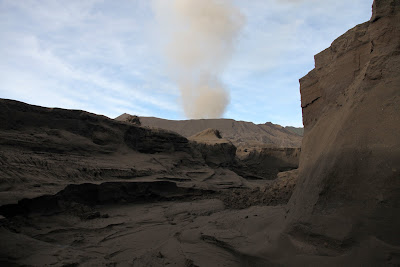
Stepping out of the minibus, the first thing you hear is something quite unexpected – the distant roar of the active volcano, down in the basin of the caldera, invisible in the dark. The air is full of volcanic dust too, gently falling, coating everything. Bromo is erupting and has been for months.
A quick plate of … something with potatoes, and to bed. Then, at 3.30am, the wake-up call to get you up the nearby Mount Penanjakan to see the sunrise over Bromo and the rest of the caldera.
We were lucky enough to see a few arcs of magma in the crater; Bromo produces ash, mostly, and little lava.
After sunrise – about 6.30am – we headed off to see the flat ash lands - called the Sea of Sand - inside the caldera, where we found an ash-choked riverbed and saw the tops of ash-covered plants. There's also a Hindu temple at the base of the mountains.
The sound here was louder. Although the guides say that climbing the side of the active Bromo is not allowed, plenty of people did go up. They said the ground shook and trembled underfoot. We saw rocks being tossed up inside the crater – we were a coupe of km away, so those rocks must have been enormous and yet they climbed lazily into the air before floating back down into the pit.
real live volcano sounds:
Back to the hotel, where we got another view of the volcanic landscape,
chicken soup (made mainly with chicken skin, it seemed – cheapskates!) for breakfast, then back on the road for the Ijen Plateau, another mildly active volcano with a lake in the crater and a sulphur mine.
But you'll have to wait for that for another day...
Bromo was 13 hours from Yogya, and the roads were mostly smooth and unrutted. But the final stretch, hairpinning up the side of the volcanic caldera in the teeming rain in the pitch dark, was the closest I've got to getting religion.
Stepping out of the minibus, the first thing you hear is something quite unexpected – the distant roar of the active volcano, down in the basin of the caldera, invisible in the dark. The air is full of volcanic dust too, gently falling, coating everything. Bromo is erupting and has been for months.
A quick plate of … something with potatoes, and to bed. Then, at 3.30am, the wake-up call to get you up the nearby Mount Penanjakan to see the sunrise over Bromo and the rest of the caldera.
 |
| From Mount Bromo and Sea of Sands, Java |
We were lucky enough to see a few arcs of magma in the crater; Bromo produces ash, mostly, and little lava.
 |
| From Mount Bromo and Sea of Sands, Java |
After sunrise – about 6.30am – we headed off to see the flat ash lands - called the Sea of Sand - inside the caldera, where we found an ash-choked riverbed and saw the tops of ash-covered plants. There's also a Hindu temple at the base of the mountains.
 |
| From Mount Bromo and Sea of Sands, Java |
 |
| From Mount Bromo and Sea of Sands, Java |
 |
| From Mount Bromo and Sea of Sands, Java |
 |
| From Mount Bromo and Sea of Sands, Java |
The sound here was louder. Although the guides say that climbing the side of the active Bromo is not allowed, plenty of people did go up. They said the ground shook and trembled underfoot. We saw rocks being tossed up inside the crater – we were a coupe of km away, so those rocks must have been enormous and yet they climbed lazily into the air before floating back down into the pit.
real live volcano sounds:
Back to the hotel, where we got another view of the volcanic landscape,
 |
| From Mount Bromo and Sea of Sands, Java |
chicken soup (made mainly with chicken skin, it seemed – cheapskates!) for breakfast, then back on the road for the Ijen Plateau, another mildly active volcano with a lake in the crater and a sulphur mine.
But you'll have to wait for that for another day...
Yogyakarta, heart and soul of Java
Despite the spelling, it's pronounced JogJakarta; in fact, everyone calls it Jogja. Even the greenest septuagenarian tourist just arrived on the platform at Tugu Station is already calling it Jogja by the time they reach the concourse.
They call this city of 700,000 Java's soul: it's the home of loads of traditional dance companies and gamelan orchestras (there are gamelan mini-orchs busking on the street corners) and batik workshops. Despite the clear and explicit description in Lonely Planet of the 'smooth-talking' salesman who manage to get you into batik galleries so the high-pressure hose sales hose can be played upon your soft parts, we managed to fall for this three times in two days; the third time, I didn't even notice the guy talking us into visiting a gallery two miles distant – he was that smooth. But I'm able to resist sales pitches all day long, so we didn't buy any batik at tourist prices. Helena did buy a lovely scarf from this old dear, named Ponor,
who was selling her cloths table to table in a cafe, but that is our only batik indulgence so far.
Away from the main arteries, the streets of Yogya are a winding labyrinth too narrow for cars, so unlike any city we've visited so far on this trip the traffic noise is soon quite muted. It's very easy to get lost.
Like most visitors to Yogya, we wanted to visit the nearby temples of Prambanan and Borobudur.
Prambanan is a Hindu temple built between the eighth and tenth centuries AD. It was abandoned when power shifted from central to east Java, and fell into disrepair and ruin over the centuries (and, as happened to many Greek and Roman buildings in Europe and Asia Minor, the locals scavenged Prambanan for ready-made stone blocks); major earthquakes reduced the temples to heaps (including a big earthquake in 2006 that shattered lots of blocks). It's being rebuilt and renovated constantly.
Borobudur is a giant stupa built around a hill, and it was abandoned soon after completion in 850AD. It lay forgotten and smothered in vegetation until Stamford Raffles rediscovered it in 1815. It's said to be a three-dimensional mandala which Tantric Buddhists use as a walk-through guide to meditation on the vicissitudes of existence and the release of Nirvana.
Both temples are constantly thronged with tourists and school parties. Which meant more requests for pictures and interviews at every step. Indonesia is a young country, and it seemed like every child at both Prambanan and Borobudur wanted a five-minute chat about our favourite foods and our holiday plans. But they were so excited at having a real native English speaker to question it would have been graceless – nay, churlish – to refuse.
We also visited the Sultan's Palace, the Kraton. There's still a Sultan and he still lives there (in fact, there's a popular movement for a referendum on Yogya separating from Indonesia, Yogya becoming much like Brunei I guess. I don't know how much chance there is of such a referendum taking place nor of the likely result, but there are pro-referendum posters and bumper stickers and penants everywhere), and the staff wear a uniform of sarong and blouse and kris – a ceremonial dagger.
We came for a performance by the royal gamelan players, which was lovely.
instrumental music:
with voices:
There's also a museum with lots of regal bits and pieces on show (including the socks the then-Sultan wore when meeting Sukarno, Indonesia's first President, to sign the Sultanate into Indonesia), plus portraits of previous Sultans and assorted family. Not all the portraits were completely flattering; perhaps they were just poorly executed. Or perhaps not:
It's like John Merrick and Ann Widdecombe had a baby.
Also on show was a royal opium pipe, quite an unexpected exhibit since the official policy now is to declare that no-one except losers with weak morals has ever taken drugs, and to execute anyone found with heroin or opium and to imprison forever in jails whose harshness can easily be imagined those with even a few crumbs of old marijuana leaf in their pocket who can't buy their way out of their predicament or point the police to someone even more important they can bust. (Having said that, I've been reading Elizabeth Pisani's book The Wisdom of Whores, about her work with the UN Aids bureaucracy, and there's a long section about Indonesia in which she describes the almost universal prevalence of all drugs, soft and hard, in all parts of this immense country. Still, I'm not tempted; it's apparently not unknown for dealers to pocket a tourist's money then tell the police that said tourist is holding. Dealer gets brownie points with cops; hapless tourist gets sent to some hellhole full of dysentery, malaria and dengue.)
We also visited the Water Castle, the Sultan's old bathing complex. Here he would frolic all day with his harem. Oh to be a Sultan.
And we also encountered infested bedding in Yogya. At first we thought we were suffering the attentions of a new kind of mosquito, but the net around our bed was intact and the slowly smouldering coils of insecticide we set beside the bed each night had never failed us before. It was on our final night in our lodgings that I finally found one of the thirsty little creatures crawling on me: like a little black worm a few millimetres long, it broke up between my fingers when I plucked it from my shoulder. Yeuch. We were both mottled with bites from these creatures. This was our first experience of blood-sucking nocturnal parasites in Indonesia; alas it was not to be our last.
But hark! - the volcanoes of Bromo and Ijen are calling....
They call this city of 700,000 Java's soul: it's the home of loads of traditional dance companies and gamelan orchestras (there are gamelan mini-orchs busking on the street corners) and batik workshops. Despite the clear and explicit description in Lonely Planet of the 'smooth-talking' salesman who manage to get you into batik galleries so the high-pressure hose sales hose can be played upon your soft parts, we managed to fall for this three times in two days; the third time, I didn't even notice the guy talking us into visiting a gallery two miles distant – he was that smooth. But I'm able to resist sales pitches all day long, so we didn't buy any batik at tourist prices. Helena did buy a lovely scarf from this old dear, named Ponor,
 |
| From Yogyakarta |
who was selling her cloths table to table in a cafe, but that is our only batik indulgence so far.
Away from the main arteries, the streets of Yogya are a winding labyrinth too narrow for cars, so unlike any city we've visited so far on this trip the traffic noise is soon quite muted. It's very easy to get lost.
 |
| From Yogya, Java |
Like most visitors to Yogya, we wanted to visit the nearby temples of Prambanan and Borobudur.
Prambanan is a Hindu temple built between the eighth and tenth centuries AD. It was abandoned when power shifted from central to east Java, and fell into disrepair and ruin over the centuries (and, as happened to many Greek and Roman buildings in Europe and Asia Minor, the locals scavenged Prambanan for ready-made stone blocks); major earthquakes reduced the temples to heaps (including a big earthquake in 2006 that shattered lots of blocks). It's being rebuilt and renovated constantly.
 |
| From Prambanan, Java |
 |
| From Prambanan, Java |
 |
| From Prambanan, Java |
Borobudur is a giant stupa built around a hill, and it was abandoned soon after completion in 850AD. It lay forgotten and smothered in vegetation until Stamford Raffles rediscovered it in 1815. It's said to be a three-dimensional mandala which Tantric Buddhists use as a walk-through guide to meditation on the vicissitudes of existence and the release of Nirvana.
 |
| From Borobudur, Java |
 |
| From Borobudur, Java |
 |
| From Borobudur, Java |
Both temples are constantly thronged with tourists and school parties. Which meant more requests for pictures and interviews at every step. Indonesia is a young country, and it seemed like every child at both Prambanan and Borobudur wanted a five-minute chat about our favourite foods and our holiday plans. But they were so excited at having a real native English speaker to question it would have been graceless – nay, churlish – to refuse.
 |
| From Borobudur, Java |
We also visited the Sultan's Palace, the Kraton. There's still a Sultan and he still lives there (in fact, there's a popular movement for a referendum on Yogya separating from Indonesia, Yogya becoming much like Brunei I guess. I don't know how much chance there is of such a referendum taking place nor of the likely result, but there are pro-referendum posters and bumper stickers and penants everywhere), and the staff wear a uniform of sarong and blouse and kris – a ceremonial dagger.
We came for a performance by the royal gamelan players, which was lovely.
 |
| From Kraton, Yogyakarta, Java |
instrumental music:
with voices:
There's also a museum with lots of regal bits and pieces on show (including the socks the then-Sultan wore when meeting Sukarno, Indonesia's first President, to sign the Sultanate into Indonesia), plus portraits of previous Sultans and assorted family. Not all the portraits were completely flattering; perhaps they were just poorly executed. Or perhaps not:
 |
| From Kraton, Yogyakarta, Java |
It's like John Merrick and Ann Widdecombe had a baby.
Also on show was a royal opium pipe, quite an unexpected exhibit since the official policy now is to declare that no-one except losers with weak morals has ever taken drugs, and to execute anyone found with heroin or opium and to imprison forever in jails whose harshness can easily be imagined those with even a few crumbs of old marijuana leaf in their pocket who can't buy their way out of their predicament or point the police to someone even more important they can bust. (Having said that, I've been reading Elizabeth Pisani's book The Wisdom of Whores, about her work with the UN Aids bureaucracy, and there's a long section about Indonesia in which she describes the almost universal prevalence of all drugs, soft and hard, in all parts of this immense country. Still, I'm not tempted; it's apparently not unknown for dealers to pocket a tourist's money then tell the police that said tourist is holding. Dealer gets brownie points with cops; hapless tourist gets sent to some hellhole full of dysentery, malaria and dengue.)
We also visited the Water Castle, the Sultan's old bathing complex. Here he would frolic all day with his harem. Oh to be a Sultan.
 |
| From Water Castle, Yogya |
And we also encountered infested bedding in Yogya. At first we thought we were suffering the attentions of a new kind of mosquito, but the net around our bed was intact and the slowly smouldering coils of insecticide we set beside the bed each night had never failed us before. It was on our final night in our lodgings that I finally found one of the thirsty little creatures crawling on me: like a little black worm a few millimetres long, it broke up between my fingers when I plucked it from my shoulder. Yeuch. We were both mottled with bites from these creatures. This was our first experience of blood-sucking nocturnal parasites in Indonesia; alas it was not to be our last.
But hark! - the volcanoes of Bromo and Ijen are calling....
Jakarta? No, she wanted to come
Jakarta was our first experience,, outside the pages of 2000AD, of a megacity. Sure, KL is big and busy and everything, but Jakarta is vastness piled upon vastness. We asked our taxi driver on the ride from the airport: how big? Officially, he said, the city of Jakarta is 9million and the greater Jakarta area is 20million. Unofficially, an estimated 30million people live in the city and environs. If you took one minute to say hello to every person in Jakarta, it would take you more than 57 years. That's if you meet and greet without pause, day and night.
It's the kind of city you could live in your whole life and you'd never get to know more than a small fraction of it. We were staying in Glodok, near Kota, which is the heart of the old city. We were there over Easter, which, I was surprised to discover, is a major public holiday in Indonesia. So we didn't really see the traffic at its most intense – even so it's indescribably busy.
It's also dirty and noisy and just … huge. You look at the fold-out city map in hotel reception (an inch-thick concertina) and wonder how the taxi drivers manage it.
There is a mass transit system called TransJakarta Busway (in that pic above, it's to the right), which is like a subway but for buses and above ground. A dozen or so dedicated lanes cut through the bumper-to-bumper jams, making it possible to get across the immense sprawl cheaply and easily. We travelled the length of Busway 1 a couple of times, from Kota in the North near the water to Plaza Semanaya in the south, a bunch of giant shopping malls of various degrees of luxury.
At the Plaza, I was looking for a voice recorder to aid with the blogging (I figure that I need some technology to keep track of my various impressions and thoughts otherwise I never remember what I want to remark upon when I finally get the time for some blogging; but then I remembered I've got an Android so I downloaded an app for zero price – huzzahs for Google!) and we wanted to compare prices for a new MacBook for the wife unit (Hong Kong is still the cheapest).
Anyway, Busway 1 takes about an hour and 20 minutes to traverse from top to bottom – and you're nowhere near the outer edge of Jakarta when you get off at Blok M, its southern terminus. (Many streets seem just to have letters or numbers for names, like the town planners or post office just gave up.)
Down in the old town area is Fatahillah Square, which fronts what would have been some colonial building for the admin of Dutch justice and is now a museum, and where I somehow ended up standing on a bloke who was lying on a pile of broken glass.
We were part of a crowd watching a performance of street magic and circus – fire-breathing, escapology, death-defying tricks with knives and so on. As the fakirs emptied a sack of broken glass on to a tarpaulin, one of them brought me a handful of shards to verify for the ring of viewers that they were real and sharp. Which I did. Then he led me by the hand to examine the cullet on the tarp; very sharp pieces, oh yes. Then he lay down on them, grimacing and yelping in a theatrical way. Another fakir took my hand and made me stand on his back. Both feet. My full weight on top of a man lying on top a pile of broken glass.
I couldn't bear the thought (even though he seemed to bear me with ease) and immediately stepped off – and they made me step back on again.
When finally they let me go I expected the other bloke to have at least minor disembowelment, but apart from some sharp indents his skin was smooth as, well, glass.
To the Museum Wayyang next – Indonesian puppetry! Every Sunday they have a performance; we were advised not to come for the 10am start but for 11am or so, when it would be a “bit livelier”. Well, if that's lively call me a cadaver. Nothing happened, twice. The gamelan accompaniment was hypnotic and lovely, but the performance involved waggling one puppet's arms then waggling the other's arms, for ever.
We went for a walk around the museum (and were given a private show of shadow puppetry by Aldy, sixth-generation puppet maker) and when we came back to the performance room about an hour later precisely nothing had changed . This particular show lasts four hours; no wonder Aldy's kids prefer PlayStation: at least something happens. It's all narrated in courtly Javanese too, which I think means the locals haven't a clue what's happening either. Incidentally - that's a sound file beneath the pic. Click that button and revel in rich stereophonic sound captured live and in person on the day.
In the museum were puppets from around the world, including a full set of Punch and Judy figures as well as many Wayyang puppet sets.
Some of the wooden ones were supposed to show real people, I'm guessing to tell stories from the Dutch colonial period:
Some from that set were much more caricatured:
I'm guessing those two at the left are supposed to represent Indonesians who helped the Dutch.
We went to the world famous Cafe Batavia (well, they say it's world famous, so who are we to contradict), which was definitely trading on its reputation. Over-priced food and drinks plus a cockroach wandering on the table. At least the toilets were fancy. They remind me of a place in Edinburgh, but I can't think where - any ideas?
We did find one oasis in the city – a cafe in a converted warehouse up towards the docks. It had private gardens, and a store room of Dutch colonial antiques and stuff.
(Helena says that pic is for you, Brian. But as far as I know, you're not interested in antiques, so I'm not sure what she's driving at.)
I was quite tired by this point.
Helena and I found ourselves to be quite exotic – everywhere we went, people (mainly but not only schoolchildren and young university students) wanted to have a picture taken with us and to engage us in conversation 'for homework'. This made progress through busy areas slow and halting, but I decided never to decline these requests – I should hate to put a child off speaking English by being unhelpful, when English may be the very thing to help them to a better future.
Remember that cicada, caught by the bat? Well, Here's the sound clip:
It's the kind of city you could live in your whole life and you'd never get to know more than a small fraction of it. We were staying in Glodok, near Kota, which is the heart of the old city. We were there over Easter, which, I was surprised to discover, is a major public holiday in Indonesia. So we didn't really see the traffic at its most intense – even so it's indescribably busy.
 |
| From Jakarta |
It's also dirty and noisy and just … huge. You look at the fold-out city map in hotel reception (an inch-thick concertina) and wonder how the taxi drivers manage it.
There is a mass transit system called TransJakarta Busway (in that pic above, it's to the right), which is like a subway but for buses and above ground. A dozen or so dedicated lanes cut through the bumper-to-bumper jams, making it possible to get across the immense sprawl cheaply and easily. We travelled the length of Busway 1 a couple of times, from Kota in the North near the water to Plaza Semanaya in the south, a bunch of giant shopping malls of various degrees of luxury.
At the Plaza, I was looking for a voice recorder to aid with the blogging (I figure that I need some technology to keep track of my various impressions and thoughts otherwise I never remember what I want to remark upon when I finally get the time for some blogging; but then I remembered I've got an Android so I downloaded an app for zero price – huzzahs for Google!) and we wanted to compare prices for a new MacBook for the wife unit (Hong Kong is still the cheapest).
Anyway, Busway 1 takes about an hour and 20 minutes to traverse from top to bottom – and you're nowhere near the outer edge of Jakarta when you get off at Blok M, its southern terminus. (Many streets seem just to have letters or numbers for names, like the town planners or post office just gave up.)
Down in the old town area is Fatahillah Square, which fronts what would have been some colonial building for the admin of Dutch justice and is now a museum, and where I somehow ended up standing on a bloke who was lying on a pile of broken glass.
 |
| From Fakirs in the square, Jakarta |
 |
| From Fakirs in the square, Jakarta |
We were part of a crowd watching a performance of street magic and circus – fire-breathing, escapology, death-defying tricks with knives and so on. As the fakirs emptied a sack of broken glass on to a tarpaulin, one of them brought me a handful of shards to verify for the ring of viewers that they were real and sharp. Which I did. Then he led me by the hand to examine the cullet on the tarp; very sharp pieces, oh yes. Then he lay down on them, grimacing and yelping in a theatrical way. Another fakir took my hand and made me stand on his back. Both feet. My full weight on top of a man lying on top a pile of broken glass.
 |
| From Fakirs in the square, Jakarta |
I couldn't bear the thought (even though he seemed to bear me with ease) and immediately stepped off – and they made me step back on again.
 |
| From Fakirs in the square, Jakarta |
When finally they let me go I expected the other bloke to have at least minor disembowelment, but apart from some sharp indents his skin was smooth as, well, glass.
To the Museum Wayyang next – Indonesian puppetry! Every Sunday they have a performance; we were advised not to come for the 10am start but for 11am or so, when it would be a “bit livelier”. Well, if that's lively call me a cadaver. Nothing happened, twice. The gamelan accompaniment was hypnotic and lovely, but the performance involved waggling one puppet's arms then waggling the other's arms, for ever.
We went for a walk around the museum (and were given a private show of shadow puppetry by Aldy, sixth-generation puppet maker) and when we came back to the performance room about an hour later precisely nothing had changed . This particular show lasts four hours; no wonder Aldy's kids prefer PlayStation: at least something happens. It's all narrated in courtly Javanese too, which I think means the locals haven't a clue what's happening either. Incidentally - that's a sound file beneath the pic. Click that button and revel in rich stereophonic sound captured live and in person on the day.
 |
| From 2011_04_24 Muzium Wayyang, Jakarta |
In the museum were puppets from around the world, including a full set of Punch and Judy figures as well as many Wayyang puppet sets.
 |
| From 2011_04_24 Muzium Wayyang, Jakarta |
 |
| From 2011_04_24 Muzium Wayyang, Jakarta |
Some of the wooden ones were supposed to show real people, I'm guessing to tell stories from the Dutch colonial period:
 |
| From 2011_04_24 Muzium Wayyang, Jakarta |
Some from that set were much more caricatured:
 |
| From 2011_04_24 Muzium Wayyang, Jakarta |
I'm guessing those two at the left are supposed to represent Indonesians who helped the Dutch.
We went to the world famous Cafe Batavia (well, they say it's world famous, so who are we to contradict), which was definitely trading on its reputation. Over-priced food and drinks plus a cockroach wandering on the table. At least the toilets were fancy. They remind me of a place in Edinburgh, but I can't think where - any ideas?
 |
| From 2011_04_23 Cafe Batavia and Fatahillah Sq, Jakarta |
We did find one oasis in the city – a cafe in a converted warehouse up towards the docks. It had private gardens, and a store room of Dutch colonial antiques and stuff.
 |
| From Jakarta |
 |
| From Jakarta |
(Helena says that pic is for you, Brian. But as far as I know, you're not interested in antiques, so I'm not sure what she's driving at.)
I was quite tired by this point.
 |
| From Jakarta |
Helena and I found ourselves to be quite exotic – everywhere we went, people (mainly but not only schoolchildren and young university students) wanted to have a picture taken with us and to engage us in conversation 'for homework'. This made progress through busy areas slow and halting, but I decided never to decline these requests – I should hate to put a child off speaking English by being unhelpful, when English may be the very thing to help them to a better future.
Remember that cicada, caught by the bat? Well, Here's the sound clip:
Subscribe to:
Posts (Atom)